Conservation Laws of a Creative Holon
A Physics-Inspired Model of Sexual Energy, Vitality, and Awareness
Context and Motivation
The Daoist tradition makes specific, structural claims about sexual energy. It asserts that the body contains a dense creative essence (jing) that can be refined into vitality (qi), which can be further refined into spiritual awareness (shen). It claims that excessive ejaculation depletes this essence, that retention conserves it, that specific practices transmute it upward through the body’s energy centers, and that the resulting awareness constitutes a genuine expansion of consciousness — not a metaphor, not a placebo, but a real transformation with observable consequences.
These are testable claims. If the Daoist framework describes something real about human energetic physiology, then we should be able to do what we do with any physical theory: formalize the assertions as mathematical relationships, build a dynamical model, simulate its behavior, and compare the predictions against observed reality.
That is what this document does.
The observed reality we’re testing against is the massive, informal dataset generated by the NoFap and semen retention communities — hundreds of thousands of practitioners reporting their experiences across a wide range of configurations. These reports are anecdotal, uncontrolled, and subject to every bias in the book. But they are also remarkably consistent in their broad structure:
- Retention produces rapid initial benefits (energy, clarity, confidence) that plateau around 30-60 days
- Retention without cultivation often deteriorates into agitation, obsessive ideation, and relapse after the initial gains
- Retention combined with physical practice (gym, martial arts, yoga) produces more stable and sustained benefits
- Retention combined with contemplative practice (meditation, breathwork, visualization) produces qualitatively different experiences — described as “inner light,” presence, spiritual aliveness
- Porn consumption degrades the benefits of retention even without ejaculation
- Recovery from chronic porn use is slow, with imaginative and creative capacity being the last thing to return
A simple reservoir model (stop draining, tank fills, benefits follow) cannot account for this pattern. It can’t explain why retention sometimes makes people feel worse, why physical cultivation helps, why contemplative practice produces qualitatively different results, or why porn damages the system independently of ejaculation.
The Daoist three-phase model — with its insistence that the intermediate phase (qi/vitality) is the obligate medium of transformation, that refinement requires specific internal conditions, and that the body’s energy follows conservation and phase-transition dynamics — can potentially account for all of it.
So let’s build the model and find out.
The approach: take the core Daoist claims, express them as coupled differential equations with explicit phase-transition coefficients, simulate the dynamics under various configurations (retention, retention + cultivation, porn consumption, partnered practice), and compare the predicted trajectories against the phenomenology that practitioners actually report.
If the model’s predictions match the observed pattern of experiences, that constitutes evidence (not proof, but evidence) that the Daoist framework is describing a real dynamical system. If the predictions diverge from observation, the model is wrong and the Daoist claims need revision or rejection.
The physics formalism is structural, not literal — the quantities (, , ) are not measurable with current instruments. But the relationships between them are precise: conservation laws, phase transitions, threshold behavior, feedback loops. These relationships make specific, falsifiable predictions about what should happen under given conditions. A practitioner can test the model against their own experience and determine whether the dynamics match.
I. State Variables and Parameters
Phase Variables
Postulate: there exists a single substance — call it (divine creative energy) — that manifests across a frequency spectrum within the holon (the fractal unit of a human body-consciousness). exists in three phases, corresponding to the Daoist Three Treasures:
- — generative essence. The densest phase. Sexual energy, biological creative potential. Analogous to ice.
- — vitality. The intermediate phase. The animating current, felt aliveness, the energy that fuels action and engagement. Analogous to liquid water.
- — awareness. The subtlest phase. Consciousness, spiritual radiance, mental clarity. Analogous to steam.
These are three phases of one field: .
The critical role of : Vitality serves two distinct roles in the model that must not be conflated:
-
Catalytic role (solvent). provides the medium in which phase transitions occur. Both the upward transmutation (jing -> qi -> shen) and downward re-infusion (shen -> qi -> jing) require adequate ambient to proceed. This role is analogous to a solvent: it facilitates reactions without being consumed by them. Mathematically, it enters the transmutation coefficients as a saturating factor.
-
Reactant role (feedstock). is also the substrate consumed by the second transmutation (qi -> shen). The term in the equations represents first-order consumption kinetics: vitality is directly consumed to produce awareness.
These are different phenomena. The catalytic role means “low slows all transitions.” The reactant role means “the transition directly consumes .” Both are real. The model captures them with different mathematical structures.
Infrastructure Variables
- — circuit coherence, in . The integrity of the holon’s internal wiring — whether heart, body, intention, and awareness are connected in a functional circuit.
- — imaginative capacity, in . The holon’s ability to self-generate creative patterns without external input.
Driving Variables (Practitioner-Controlled)
- — heart engagement, in . How much the heart center is active in the circuit.
- — embodiment, in . How much awareness is present in the body.
- — external stimulation, . Volume of externally consumed sexual/erotic content.
- — novelty escalation rate, . Rate of escalation from tolerance (not novelty per se).
- — generative fraction, in . Fraction of creative/erotic content self-generated vs. externally consumed.
- — reciprocity, in . Degree of genuine reciprocal exchange with another holon.
- — ejaculatory discharge, . Pulsed drain on .
- — environmental support for vitality, . Sleep, nutrition, exercise contribution to .
- — vitality drain from stress and overstimulation, . Chronic stress, emotional reactivity, and the metabolic cost of sustained arousal states drain independently of the congestion mechanism.
II. Endogenous Generation
The holon is not a battery. It is a spring.
A living body continuously produces as an intrinsic function of being alive. This production is endogenous, always-on, and a defining property of the living holon.
Define the effective endogenous generation rate:
Where:
- is the constitutional baseline generation rate (varies by individual — age, genetics, overall health). as long as the holon is alive.
- is a vitality-modulation function that captures the dependence of jing production on system health:
is a small floor (generation never fully ceases in a living system, but can be severely suppressed). is the half-saturation constant. When is healthy, and . When is severely depleted, and drops to .
This creates a feedback loop absent from a constant- model: chronic depletion reduces , which reduces the feedstock for , which further reduces replenishment from below. This is the “death spiral” of severe chronic illness or extreme burnout, where the body’s regenerative capacity itself degrades.
The spring always flows, but the flow rate depends on the health of the aquifer.
III. The Phase Equations
The phase equations are the primary dynamical specification. All aggregate quantities are derived from them.
Verification: Conservation Consistency
Summing all three equations yields:
Note that all and terms cancel in the sum — as they must, since transmutation and re-infusion redistribute between phases without creating or destroying it. The only terms that survive are sources (, ), sinks (, , the congestion drain), and dissipation (the three terms). This is the model’s conservation law: changes only through generation, environmental support, discharge, dissipation, and congestion stress. Internal phase transitions are conservative.
(Exchange terms would also survive the sum; they are treated separately in Section VIII.)
Design Choices and Their Justifications
is absent. The equation has no environmental source term. This is a deliberate modeling choice reflecting the Daoist claim that awareness cannot be acquired directly from the environment — it must be transmuted from vitality through functioning infrastructure. You cannot eat, sleep, or supplement your way to shen. You must refine it from qi. If this claim is wrong — if, say, exposure to nature or music directly produces — then an term should be added, but this would weaken the obligate-intermediate architecture that gives the model its predictive structure.
The congestion coupling term: . This is the mechanism by which untransmuted dense energy drains vitality. When exceeds its natural equilibrium level (defined below in steady-state analysis), the excess creates agitation — restlessness, obsessive ideation, physiological stress — that is metabolically expensive and consumes . The drain is proportional to both the excess (more congestion = more stress) and the available vitality (you can’t drain what isn’t there). is the congestion-stress coefficient. This term creates the positive feedback loop between congestion and vitality depletion that drives the “retention without cultivation deteriorates” prediction. Without it, this prediction — one of the model’s most important — would not follow from the equations.
and are infrastructure-independent. The upward transmutation coefficients and depend on circuit coherence and imaginative capacity , because transmutation is an anti-entropic process — it refines dense energy into subtle energy, which is thermodynamically uphill and requires active work by the system’s infrastructure. Re-infusion (, ) is the reverse: subtle energy condensing into denser forms, which is thermodynamically downhill — entropically favored. A fragmented system can still “cool” its energy from subtle to dense; it just can’t “heat” it from dense to subtle. This is analogous to how heat flows spontaneously from hot to cold but requires a heat engine (infrastructure) to flow from cold to hot. Accordingly, and are treated as constants independent of and .
IV. The Transmutation Coefficients
The Catalytic Dependency on
Both transmutation coefficients require adequate ambient vitality to proceed. This is the solvent/catalytic role of — distinct from its reactant role — captured by saturating functions:
The floor terms , are critical. They ensure that the transmutation coefficients never reach exactly zero, which resolves the bootstrap problem: if were allowed to reach zero at , the system would have an absorbing state from which no recovery is possible — means no new can be produced from jing, and the system is permanently stuck. The floor ensures that even at severely depleted , a trickle of transmutation occurs. Combined with (environmental vitality support from food, sleep, breath), this trickle is sufficient to gradually rebuild from near-zero. The system is recoverable from any non-death state.
The floor values should be small (, —) — transmutation at near-zero vitality is very slow, but not impossible. This matches the phenomenology of recovery from severe depletion: progress is initially glacial, then accelerates as rebuilds and , climb toward 1.
The Full Coefficients
Where:
- , are baseline transmutation capacities (constitutional, vary by individual)
- , make both coefficients superlinear in circuit coherence
- , make both coefficients superlinear in imaginative capacity
- , are the saturating catalytic functions defined above
Key asymmetry: The second transition is more demanding:
- — lower baseline rate
- — more sensitive to circuit coherence
- — more sensitive to imaginative capacity
It’s easier to convert sexual energy into vitality than to convert vitality into awareness. The first transition responds to basic practices. The second requires refined infrastructure.
Superlinearity and Threshold Behavior
The exponents , produce threshold behavior: and don’t decline linearly as and degrade — they collapse. Small degradations produce outsized reductions. There is a critical region below which transmutation effectively stalls (though it never reaches exactly zero, thanks to the , floors). These thresholds are formally defined in the steady-state analysis below.
V. The Infrastructure Dynamics
Circuit Coherence
All degradation terms now include a factor of : you can only degrade coherence you actually have. This ensures is respected by the dynamics — at , the degradation terms vanish (no coherence to lose), but the growth terms and remain positive, so is not an absorbing boundary: the system can recover from zero coherence through heart-engaged embodied practice or reciprocal connection. is absorbing only when and simultaneously — complete absence of both heart-embodied practice and reciprocity. is bounded by the factors on the growth terms. The equation is well-posed on .
Term by term:
- : Coherence builds when heart is engaged and experience is embodied. Bounded by .
- : External stimulation without embodiment degrades existing coherence. The factor ensures degradation vanishes as coherence approaches zero.
- : Novelty escalation degrades existing coherence. No compensating factor beyond the floor — escalation from tolerance is always destructive.
- : Reciprocity builds coherence. Bounded by to prevent .
Imaginative Capacity
Well-posed on : the growth term vanishes at and the decay terms vanish at .
Term by term:
- : Imagination builds when the holon self-generates its creative content. Like a muscle — use it and it grows.
- : External stimulation consumption atrophies imagination. Exponential decay under sustained consumption.
- : Disuse atrophy. Imagination decays not only from active damage (external stimulation) but also from simple neglect. When , the imaginative faculty is not being fully exercised, and it weakens — like a muscle that atrophies from disuse, not just from injury. When , this term vanishes. This captures a crucial asymmetry in recovery: stopping external stimulation () is necessary but not sufficient. The practitioner must actively exercise the faculty (), not merely abstain from damaging it.
VI. Steady-State Analysis
Setting all time derivatives to zero reveals the equilibrium structure of the system.
Simplified Steady State (No Discharge, No Congestion, No Exchange)
For analytic tractability, consider the core system with , , , and infrastructure at steady values , . The phase equations become:
Where and .
From the third equation:
Substituting into the second:
Define the effective qi drain rate:
Then:
And from the first equation:
Substituting the expression and solving:
Since and , the denominator is positive and the equilibrium exists.
The Natural Equilibrium Level
In the limit where is small (minimal transmutation), the jing equilibrium reduces to:
This is the natural equilibrium level — the steady state of when the spring () is balanced only by natural dissipation (). It is finite, not infinite. Under retention without cultivation, rises toward this level, not toward infinity. The congestion term in the equation uses this as the reference: congestion stress occurs when exceeds , which happens transiently during the accumulation phase or when environmental conditions (e.g., porn-induced arousal) drive above its natural resting point.
Note: can still be uncomfortably high. If is small (dense energy is durable), the equilibrium level may be large enough to produce significant congestion pressure even though it is mathematically bounded. The phenomenology of escalating discomfort under retention is real — it’s the approach to a high equilibrium, not unbounded growth.
A subtlety: is itself a moving target. Since depends on through the modulation, a decline in vitality lowers , which lowers , which means congestion kicks in at a lower level. This creates an additional positive feedback loop beyond the direct congestion-vitality coupling: drops drops drops congestion activates sooner drops further. This amplifies the “death spiral” dynamics of severe depletion and means that a holon experiencing chronic vitality drain becomes progressively more congestion-sensitive even without changes in .
Formal Threshold Definitions
The threshold is the minimum value of at which the system sustains above a functional minimum (the level at which vitality is experientially adequate):
This is an implicit inequality ( appears on both sides), but for it simplifies to:
This reveals the controlling ratios: the threshold is higher when drains faster (large ), when the minimum viable vitality is higher (large ), and when the source flux is weaker (small ). A constitutionally vigorous holon (high , low ) has a lower threshold — it can sustain adequate vitality with less infrastructure.
The threshold is the minimum value of at which the system sustains above a functional minimum (the level at which awareness is experientially present):
Since itself depends on , this threshold can only be crossed when is already above its threshold — confirming the staircase structure. You must cross before becomes crossable.
Stability
The Jacobian of the simplified three-phase system (ignoring the dependence on for local analysis) has eigenvalues with negative real parts whenever all , , — the equilibrium is a locally stable node. Perturbations decay exponentially in a neighborhood of the steady state. This means the model predicts return to equilibrium after disruption, with timescales set by the eigenvalues. The slowest eigenvalue (smallest ) determines the system’s recovery time — this is dominated by the smallest of (, effective qi drain rate, effective shen drain rate).
VII. Dimensionless Analysis
The model has many parameters. Nondimensionalization reveals which combinations actually control the dynamics.
Natural scales:
- Energy: (the natural jing equilibrium under zero transmutation)
- Time: (the vitality dissipation timescale — the “middle clock”)
Dimensionless state variables:
Key dimensionless groups:
The system’s behavior is governed by these seven dimensionless ratios (plus the infrastructure exponents , , , and the saturation parameters). This is a significant reduction from the ~20 raw parameters.
What the dimensionless groups reveal:
- means jing is much more durable than qi. The dense reservoir changes slowly relative to vitality — consistent with the observation that sexual energy is the most resilient treasure.
- means shen dissipates much faster than qi. Spiritual clarity is the most fragile state — consistent with the universal observation that meditative insight is hard to maintain.
- vs controls the relative ease of the two transitions. means the second transition is intrinsically harder.
- controls how aggressively congestion drains vitality. If is large, even modest jing excess above equilibrium causes significant qi drain. If is small, the holon tolerates congestion better.
Natural timescales (in dimensional units):
- Jing recovery: (slowest — days to weeks)
- Qi recovery: (medium — weeks)
- Shen recovery: (fastest dissipation, but slowest production because it requires functioning infrastructure)
The paradox of shen: it dissipates fastest but recovers slowest. This is because dissipation is passive (governed by ) but production is active (governed by , which requires infrastructure). Fast dissipation + slow production = the most fragile treasure.
VIII. The Exchange Term: Partnered Practice
The claim that for both partners simultaneously requires formal justification.
Model: When two holons interact in sacred partnered practice, they generate a shared coherence field that feeds back into each holon’s :
Where is a coupling constant and , index the two holons. The exchange term for each holon is:
Where is the absorption efficiency.
Why this is non-zero-sum: The total system energy changes by:
The “extra” energy comes from the coherence of the interaction itself — the geometric mean is maximized when the two values are equal and positive (balanced exchange), and the products ensure the energy only flows when both holons have intact, heart-open circuits. This is analogous to constructive wave interference: two coherent waves produce a combined amplitude that exceeds the sum of individual amplitudes. The coherence condition (both and high in both partners) is the “phase-matching” requirement.
This formalization makes the non-zero-sum prediction contingent on specific conditions: both partners must have adequate , both must have intact circuits (), and both must have heart engagement (). If any of these fail, and the exchange vanishes. Casual or disconnected sex produces no resonance bonus.
Simplification noted: The model routes all exchange through . A natural generalization would include phase-specific exchange terms — (physical resonance), (vitality exchange), (shared meditative states) — reflecting the observation that different partnered practices emphasize different phases: physical practices emphasize , heart-centered practices emphasize , and shared contemplative practice emphasizes . The qi-only model captures the dominant mechanism (since is the rate-limiting reagent) but may underestimate the benefits of practices that directly exchange dense or subtle energy.
IX. Applying the Model: The Retention Spectrum
Pure Retention, No Cultivation
, , , , , . No breathwork, no meditation, no physical practice beyond baseline. (assuming adequate initially).
The “superpowers” transient, explained mechanistically:
The initial benefits of retention require explanation: the reported experiences (confidence, clarity, social magnetism) are phenomenologically associated with and , not . If is moderate, how does jing accumulation produce qi-level and shen-level effects?
The answer is in the product . Under habitual ejaculation, oscillates near a low steady state. When discharge stops, begins rising roughly as:
approaching its equilibrium exponentially from below. The flux of production is , which rises in proportion. Even if is small, the increase in this flux relative to the pre-retention baseline is significant — the flux may double or triple from its chronically-depleted baseline.
This transient increase in production generates a surplus of vitality above the chronic baseline. Some of this surplus transmutes further via into (even a small applied to above-baseline produces above-baseline ). The practitioner experiences this surplus as increased vitality, mental clarity, and confidence.
The plateau and reversal:
The surplus is transient because is approaching a finite equilibrium (). As nears equilibrium, its growth rate declines, the flux increase saturates, and the transient surplus dissipates. The system settles into a new steady state where the level is modestly higher than the pre-retention baseline — but not dramatically so, because was never large enough to convert most of the accumulated .
Meanwhile, congestion effects begin. As rises above the level that the system is equipped to process (i.e., above what can transmute at the rate produces), the congestion term activates. This begins draining — partially or fully offsetting the modest gains from improved flux. The practitioner feels the vitality surplus eroding, replaced by agitation from the untransmutable excess.
The model predicts: Initial benefits that are real, peak at roughly the timescale (days to weeks), then plateau and potentially reverse as the system settles near a high-jing steady state with congestion. This matches the 30-60 day plateau followed by agitation that the retention community widely reports.
Retention with Physical Cultivation
, , , , , . Active breathwork, physical practice, some embodied awareness. .
The change: strengthens the growth term in . begins building. is elevated (physical practice directly supports vitality). With rising , increases superlinearly. More importantly, the higher flux efficiently converts the accumulated jing into qi, relieving congestion pressure.
The result: transmutes into efficiently. The congestion term stays small because doesn’t accumulate far beyond what can process. The practitioner feels sustained vitality, physical vigor, creative energy, emotional stability.
The limitation: may remain below threshold. Physical practice builds but not necessarily (heart engagement) or (imagination). With and , the second transition is more demanding. The practitioner reaches the vitality-only regime — the “healthy animal” plateau.
The model predicts: Stable, sustainable benefits with no congestion. A ceiling on development that physical cultivation alone can’t break through. This matches the experience of practitioners who combine retention with gym/sports/martial arts — they feel great but report that “something more” remains inaccessible.
Retention with Full Cultivation
, , , , , , (solo). Breathwork, physical practice, meditation, visualization, devotional practice. .
All infrastructure variables are being actively developed. Both and cross their respective thresholds.
The result: Full three-phase circulation. transmutes to , transmutes to , re-infuses via (grace organizing vitality), re-infuses via (vitality nourishing the base). The holon breathes.
The accelerating returns: Once crosses threshold, a positive feedback loop activates. production improves the felt quality of awareness, which supports more refined practice, which builds and further, which increases , which produces more . The superlinear exponents mean this is self-reinforcing once it crosses the threshold. This is the exponential growth phase that serious practitioners describe — not linear progress, but threshold-crossing followed by accelerating coherence.
Habitual Ejaculation, No External Stimulation
(periodic), , , , , . .
oscillates around a steady state where roughly balances . With low and , is small, so most of the production is lost to discharge and dissipation rather than transmuted.
is maintained at biological baseline by (food, sleep, metabolism). is near zero — is far below threshold.
The model predicts: The baseline human condition. Sexually active, physically functional, spiritually dormant. Treading water. The spring flows, fills the pool to a steady state, and that’s it.
Habitual Ejaculation with Porn
(frequent), = high, = escalating, , , . (initially).
Everything from the previous scenario, plus active infrastructure degradation. is strongly negative ( terms dominating). is strongly negative ( producing exponential decay).
is chronically low (frequent discharge, though keeps it from zero). is declining from stress/overstimulation drain () and from inability to replenish via from below. is absent.
Over the long term, if drops far enough, itself begins declining via the modulation — the death spiral where the spring weakens because the aquifer is depleted.
The model predicts: Progressive decline across all axes. The practitioner falls through both thresholds. Eventually is the only significant positive term in the system.
Recovery note: never reaches zero (). The moment , , and are set to zero, begins accumulating immediately. The initial NoFap gains are fast because they’re just unblocking a perpetual (if weakened) spring. The harder work is rebuilding and , which don’t recover just because consumption stopped.
Retention with Porn
, = high, = escalating, , , . .
The configuration the model most urgently warns about.
is running. . rises toward — a finite but potentially high level. But is collapsing ( and in free fall). The transmutation capacity can’t keep up with the accumulation.
As rises above what can process, the congestion term activates, draining . Meanwhile is also being drained by the agitation of the porn trance itself ( from overstimulation). The solvent is attacked from two directions.
Three simultaneous failure modes:
- Dense congestion: rising toward a high equilibrium with inadequate to process it
- Intermediate depletion: draining from congestion stress + overstimulation without replenishment from below
- Subtle starvation: inaccessible ( and insufficient feedstock)
Plus infrastructure destruction in the background — even if the practitioner stops viewing, the coefficients won’t recover without sustained rebuilding.
The model predicts: On a long enough timescale, worse than porn with ejaculation. Ejaculation at least relieves the congestion pressure (reducing the term). Here, the pressure builds toward the high equilibrium while the solvent depletes and infrastructure degrades. This predicts escalating agitation, obsessive ideation, and eventual forced relapse — the system becomes so pressurized that it overwhelms willpower.
Sacred Partnered Practice with Retention
, , , , , , . Both partners generating, exchanging, circulating. (both holons).
The unique feature: the exchange term for both partners. is supplemented from below () AND from the resonance field (). This directly feeds the solvent layer — the rate-limiting reagent in every other configuration.
The model predicts: Maximum generation, maximum coherence, maximum development. The resonance amplification supplements , which is the bottleneck everywhere else. This is why sacred partnered practice is consistently described across traditions as more powerful than solo practice.
X. Key Predictions
1. The spring is bounded but high.
always. under retention approaches — finite, not infinite, but potentially uncomfortably high. Initial retention gains are fast and reliable because the spring was always flowing. Congestion is real but bounded.
2. Infrastructure dominates reservoir.
The transmutation coefficients mean infrastructure variables dominate productive capacity. A holon with moderate but high and outperforms a holon with high but degraded and . Obsessing over retention while ignoring circuit coherence and imaginative capacity is optimizing the wrong variable.
3. Two critical thresholds exist and are formally computable.
and are defined by the steady-state inequalities. They sit at different positions in the space because is more sensitive to both variables. The most common state is above but below : physically vital, spiritually dormant. The “healthy animal” regime.
4. The vitality bottleneck is the hidden failure mode.
depletion collapses both coefficients via the catalytic dependency AND suppresses via the generation modulation. The modern epidemic is low : screen time, chronic stress, sleep deprivation, sedentary lifestyles all drain the intermediate reservoir. The transmutation pathway may be intact but has no medium to operate in.
5. Imagination is the bottleneck for the higher transition.
means affects more than . The imaginative faculty used in erotic visualization and in contemplative practice are the same faculty. Outsourcing it atrophies the capacity for the transition across all domains.
6. Congestion drains vitality via an explicit feedback loop.
The term creates a positive feedback loop: congestion drain lower (via catalytic dependency) worse congestion more drain. This is why retention without cultivation becomes increasingly uncomfortable rather than plateauing comfortably at equilibrium.
7. Novelty escalation is a pure coherence tax.
always degrades coherence. No compensating factor. Structurally incompatible with coherence maintenance regardless of other variables.
8. Reciprocity is non-zero-sum under formally specified conditions.
The shared field produces for both partners when , , and are adequate in both. The non-zero-sum property derives from the geometric mean structure of the coupling. It vanishes when coherence, heart engagement, or vitality fails in either partner.
XI. The Phase Diagram
The true phase space is five-dimensional (, , , , ). The thresholds are surfaces in this space, not lines. The one-dimensional diagram below is a projection onto a composite axis that assumes , , and co-vary, which is approximately true for the scenarios analyzed but not universally valid — the model permits states like “high with low ” (physically vital but imaginatively atrophied) that don’t fall on this axis.
                        high C, high I, adequate φ_qi
                              |
              FULL CIRCULATION |
                REGIME         |  κ₁_eff > κ₁_thresh AND κ₂_eff > κ₂_thresh
                               |  All three phases in dynamic equilibrium
                               |  Clarity, presence, inner radiance
             ..................|.................  <-- κ₂ threshold surface
                               |
              VITALITY-ONLY    |  κ₁_eff > κ₁_thresh, κ₂_eff < κ₂_thresh
                REGIME         |  φ_jing -> φ_qi works, φ_qi -> φ_shen stalled
                               |  The "healthy animal" plateau
             ..................|.................  <-- κ₁ threshold surface
                               |
              DISSIPATIVE      |  κ₁_eff < κ₁_thresh
                REGIME         |  Neither transition sustains functional output
                               |  Dense congestion or depletion, system fragmenting
                              |
                        low C, low I, depleted φ_qi
A more informative representation would project onto the - plane at fixed , drawing the and threshold curves as iso-contours. Since , the threshold curves are:
These are power-law curves in the - plane. Because and , the curve sits above and to the right of the curve — requiring higher and . As decreases, both curves shift outward (higher , required), consistent with the vitality bottleneck prediction.
XII. Recovery Dynamics
The model predicts asymmetric recovery timescales:
| Variable | Recovery Driver | Timescale | Notes |
|---|---|---|---|
| (always on) + retention | Fastest. Close the drain. Spring was always flowing. | ||
| + flux from below | The actual bottleneck. Requires both environmental support AND functioning . | ||
| flux from | for dissipation, but production timescale is which can be very long | Cannot be replenished directly. Must be transmuted through functioning infrastructure. | |
| growth | Decelerates as increases. | ||
| growth | Slowest. Requires active self-generation (), not just abstinence from consumption. |
The recovery sequence:
- Close the drain. , , . accumulates from . This is where fast initial gains come from.
- Refill the solvent. Sleep, nutrition, exercise, breathwork, stress reduction. Rebuild via . This supports (via the modulation) and enables (via the catalytic dependency).
- Rebuild . Heart-open, embodied presence. This is where most retention practitioners stop, yielding the vitality-only plateau.
- Rebuild . Active imagination exercises — visualization, creative practice, meditation with internal imagery. The key is self-generated content with no external input. Slowest step.
- Cross threshold. Sustained vitality, not just sexual pressure.
- Cross threshold. Clarity, presence, inner radiance as stable states.
- Full circulation. The holon breathes at all three levels. feeds the cycle continuously.
Full recovery is possible — all variables are bounded with no permanent damage ceiling. The bootstrap problem is resolved by the floor on and the environmental support term. But timescales stack, and the total arc from deep depletion to full circulation is measured in years.
XIII. Simulation Results
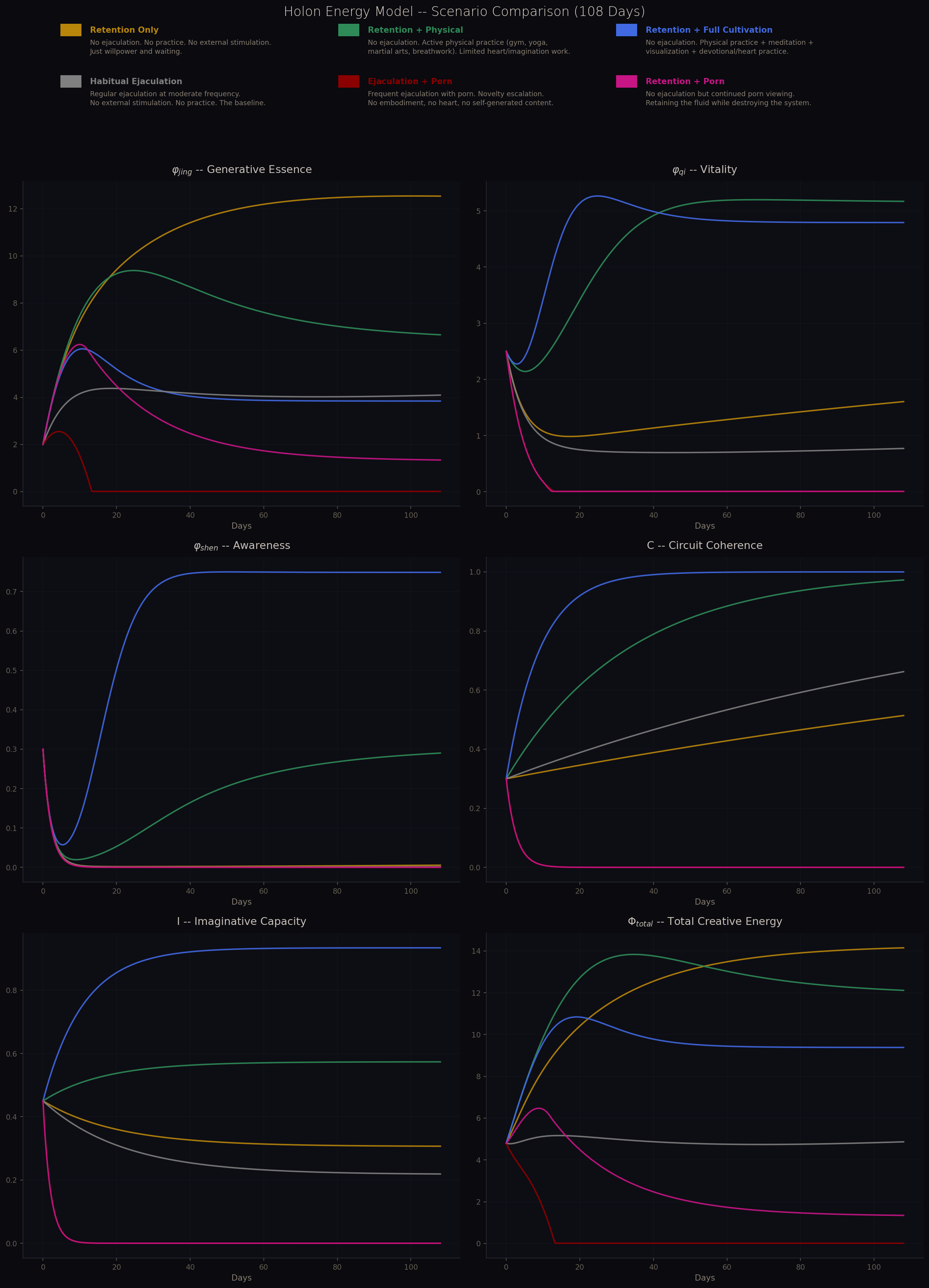
The model was implemented as a coupled ODE system in Python (scipy.integrate.solve_ivp, LSODA integrator) and simulated across six practitioner scenarios for 108 days. This timescale was chosen for two reasons: practically, it spans the critical window where retention practitioners report the full arc from initial gains through plateau to either sustained benefit or deterioration (most reports describe decisive divergence between 60-90 days). The number 108 also carries significance in Buddhist and Daoist contemplative traditions (108 mala beads, 108 energy channels), making it a natural period for a model rooted in these frameworks.
All six scenarios start from identical initial conditions representing a chronic baseline: moderate , moderate , low , low circuit coherence (), and moderate imaginative capacity (). The scenarios differ only in the practitioner-controlled driving variables: discharge rate, external stimulation, heart engagement, embodiment, generative fraction, and environmental vitality support.
What the simulation confirms
The “superpowers” transient is visible. In the Retention Only scenario (gold), spikes briefly around day 10-15 as the flux increases — the transient vitality surplus that produces the early benefits. It then declines as saturates and the congestion coupling term begins draining vitality. By day 108, the Retention Only practitioner has less vitality than their starting baseline, despite accumulating to 12.5. The spring is flowing. The pool is full. But the congestion is eating the solvent.
The three retention tiers separate cleanly. Retention Only (gold) accumulates jing but loses vitality and awareness. Retention + Physical (green) efficiently transmutes jing into vitality (strong ) but produces only modest awareness — the vitality-only plateau is visible as the gap between the green and blue curves in the panel. Retention + Full Cultivation (blue) produces strong and still-accelerating awareness at day 108 — the threshold crossing is visible as the inflection point around day 30 where the blue curve bends upward.
Infrastructure divergence drives outcome divergence. The (Imaginative Capacity) panel tells the real story. Full Cultivation pushes to 0.93. Physical Cultivation stabilizes at 0.57. Retention Only declines to 0.31. The baseline and porn scenarios collapse. Since depends superlinearly on (exponent ), these differences produce enormous differences in the transmutation rate. The infrastructure is where the trajectories diverge, not the reservoir.
Porn destroys the system on the same timescale regardless of retention. Both porn scenarios (red and pink) reach , by approximately day 40. The infrastructure collapses identically whether or not the practitioner is ejaculating. The only difference is the trajectory: Ejaculation + Porn (red) depletes to near-zero, while Retention + Porn (pink) stabilizes at 1.3 — the spring is still flowing, the fluid is retained, but the system is completely destroyed. The “retention” in Retention + Porn is meaningless at the system level. You’re retaining the fluid while the pipes corrode.
Total reveals the full picture. The panel (bottom right) shows total creative energy across all three phases. Full Cultivation produces the highest total at day 108 despite having less than Retention Only — because it has converted dense energy into higher phases. Retention Only has high total energy but it’s almost entirely trapped in the dense phase, unconverted and generating congestion. The porn scenarios approach zero total energy. The ranking by does not match the ranking by — which is the model’s central argument in a single chart: the reservoir is not the system.
What the simulation adds beyond the analytic predictions
The simulation reveals dynamics that the steady-state analysis couldn’t: the timescales of divergence. At day 30, most scenarios are still relatively close together — the differences are emerging but not dramatic. By day 60, the trajectories have separated decisively. By day 108, the outcomes are radically different despite identical starting conditions. The implication for practitioners: the first month is ambiguous. The second month is when the chosen path begins to manifest clearly. The third month is when the consequences become irreversible on any short timescale.
The simulation also reveals the shape of the transitions. The threshold crossing in Full Cultivation (the blue curve) doesn’t look like a step function — it looks like a sigmoid. There is a slow approach, a rapid acceleration, and a gradual saturation. The “click” that practitioners describe — the moment when spiritual practice suddenly becomes effortless and productive — corresponds to the inflection point of this sigmoid, which the simulation places around day 30-40 for the Full Cultivation parameter set. Before the inflection, progress feels slow. After it, the system is in positive feedback and gains accelerate.
XIV. Conclusion
The Daoist tradition claims that the body’s sexual energy is the densest phase of a creative force that can be refined into vitality and spiritual awareness through specific practices. This document formalizes those claims as a coupled ODE system with five state variables, two phase-transition boundaries, and an endogenous generation term — then tests the model against the phenomenology reported by hundreds of thousands of retention practitioners.
The model’s predictions match observed experience across the full range of configurations:
- Rapid initial gains from retention that plateau around 30-60 days
- Deterioration into agitation and relapse under retention without cultivation
- Stable benefits from retention combined with physical practice, with a ceiling
- Qualitatively different (and still accelerating) results from retention combined with contemplative and heart practice
- Infrastructure destruction from porn regardless of retention status
- Imaginative capacity as the slowest variable to recover
This correspondence does not prove the Daoist framework is literally true. The model’s quantities are not directly measurable, and with ~20 free parameters, fitting six qualitative patterns is not in itself remarkable — any sufficiently flexible model could match isolated observations. What is remarkable is that the model achieves this fit with a minimal dynamical structure: removing any single component (the obligate intermediate, the infrastructure variables, the congestion coupling, the endogenous generation) causes specific predictions to fail. The three-phase architecture is not chosen for flexibility but for necessity — it is the simplest dynamical system consistent with both the traditional claims and the practitioner reports. The evidence is not precision of fit but minimum sufficient complexity.
The central insight of the model is not about retention. It is about infrastructure. The transmutation coefficients and depend superlinearly on circuit coherence and imaginative capacity. This means the system’s productive capacity is dominated by the quality of its internal wiring, not the quantity of its stored energy. A holon with moderate reserves and strong infrastructure vastly outperforms a holon with massive reserves and degraded infrastructure. The retention communities have correctly identified that the reservoir matters — but the model shows that the reservoir is the least important variable in the system. What matters is what you build around the spring.
The model also identifies the variable that current discourse most dangerously ignores: , the vitality layer. Screen time, chronic stress, sleep deprivation, and overstimulation drain vitality independently of sexual behavior. The transmutation pathway requires adequate as both feedstock and catalytic medium. Without it, all infrastructure is inert. The modern epidemic is not insufficient sexual energy — it is insufficient vitality to do anything with it.
Falsifiability
The introduction promised falsifiable predictions. Here they are — observations that, if confirmed, would require revising the model’s structure, not merely its parameters:
-
If retention combined with full cultivation produced worse outcomes than retention alone, the superlinear infrastructure model () is wrong. The model categorically predicts that building and improves transmutation; any configuration where high and degrade outcomes would invalidate the core mechanism.
-
If porn consumption had no measurable effect on practitioner outcomes when controlling for ejaculation frequency, the / degradation mechanism is wrong. The model predicts that porn damages the system independently of discharge through the and terms. If the damage is fully explained by ejaculation alone, these terms are unnecessary.
-
If imaginative capacity recovered faster than vitality after cessation of chronic consumption, the timescale ordering ( slowest, faster) is wrong. The model’s and parameters produce slow recovery by construction; if practitioners report imagination returning before physical vitality, the recovery dynamics need revision.
-
If the “superpowers” transient did not exist — if retention produced only gradual, linear benefits with no early spike — the congestion-driven transient surplus mechanism is wrong. The model specifically predicts a non-monotonic trajectory (spike then plateau/decline) for the Retention Only configuration.
-
If sacred partnered practice with full heart engagement and mutual coherence produced outcomes no better than solo practice, the non-zero-sum exchange mechanism ( term) is wrong. The model predicts a qualitative advantage from resonance that should be distinguishable from “two people practicing solo in the same room.”
These are structural predictions. Parameter tuning cannot rescue the model from any of these failures — each targets a specific architectural feature of the equations.
Parameter Sensitivity
The model’s ~20 parameters raise a legitimate question: which predictions are robust and which are parameter-dependent?
Robust predictions (hold across all reasonable parameter ranges):
- The ordering of scenarios: Full Cultivation > Physical > Retention Only > Baseline. This follows from the superlinear structure — higher and always produce higher , regardless of specific exponent values, as long as , .
- The existence of two distinct thresholds ( and ) with harder to cross. This follows from and , .
- Infrastructure destruction from porn regardless of retention status. This follows from the sign structure of the and equations — always degrades both variables.
Parameter-sensitive predictions:
- The timing of the superpowers transient (30-60 days) depends on and . Different values shift the peak earlier or later.
- The severity of congestion effects depends on . Small produces mild discomfort; large produces debilitating agitation.
- The rate of infrastructure destruction from porn depends on , , and . These determine whether and collapse in weeks or months.
The qualitative story is robust. The quantitative timescales are not. This is appropriate for a model whose quantities are not directly measurable — the structural predictions are testable against practitioner experience even though the exact timing varies by individual.
Finally, the model offers a formal answer to the question that motivated this investigation: what is wrong with porn, from the perspective of these traditions? The answer is not moralistic. It is structural. Porn degrades circuit coherence () and imaginative capacity () — the two infrastructure variables on which all transmutation depends — on a timescale of weeks. It does this regardless of whether the practitioner ejaculates. The damage is to the system, not the reservoir. And the slowest variable to recover (, imaginative capacity) is the one most critical for the higher transition (), because the exponent means the second transmutation is more sensitive to imagination than the first.
The spring is always flowing. The question is what you build around it.
And now we have the equations to tell you exactly what to build, in what order, and why.
XV. Interactive Simulator
Interactive Simulator
Define life events and watch the model predict how your energy system evolves over 108 days. Everything runs locally in your browser.